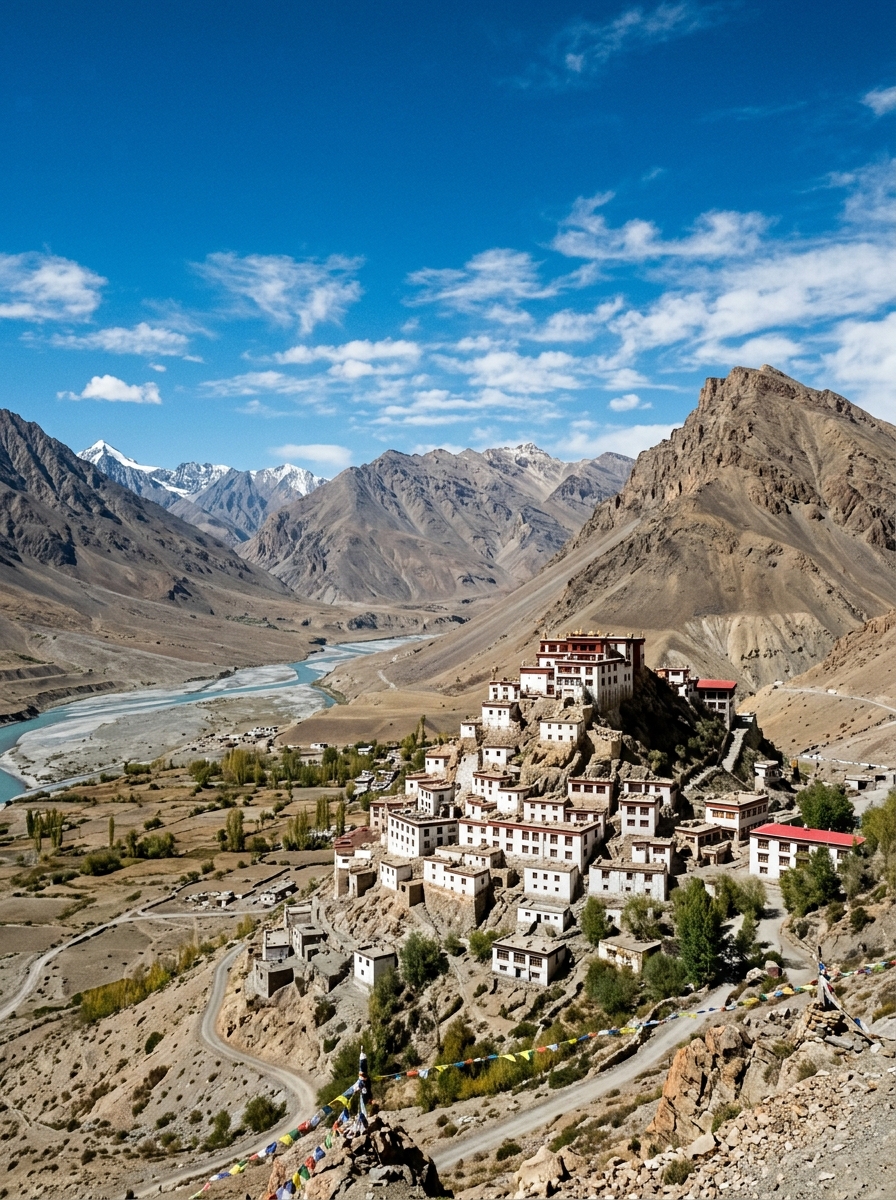
If you are someone who loves mountains but hesitates to plan a Himalayan getaway in July due to the fear of heavy monsoon rains, landslides, and road blockages, we have good news for you. Tucked away in the northeastern part of Himachal Pradesh lies Spiti Valley, a pristine, high-altitude cold desert that remains virtually dry throughout the monsoon season.
Spiti, which translates to “The Middle Land” (the land between India and Tibet), lies in the rain-shadow region of the Great Himalayas. The towering mountain ranges block the rain-bearing monsoon clouds from entering the valley. As a result, while the plains of India are drenched and the foothills of Himachal experience heavy downpours, Spiti enjoys clear blue skies, bright sunshine, and dry roads.
July is widely considered the absolute peak and best time to visit Spiti Valley. In this comprehensive guide, we will cover the routes, permits, must-visit spots, a detailed 8-day itinerary, and crucial preparation tips for your dream Spiti adventure.
—
Spiti Valley Quick Travel Info
Before packing your bags, here are the essential details of Spiti Valley in July:
| Feature | Details |
|---|---|
| July Temperature | 10°C to 22°C (Days are warm and sunny; nights are cold, dropping to 5°C) |
| Monsoon Status | Rain-shadow zone. Negligible rainfall inside the valley. |
| Road Status | Both entry points (via Shimla and via Manali/Kunzum Pass) are fully open. |
| Best Travel Mode | High-clearance SUV (4×4 or 4×2 like Scorpio, Innova) or Adventure Motorcycle. |
| Permits Required | None for Indian nationals. Foreign nationals require an Inner Line Permit (ILP). |
—
The Two Entry Routes to Spiti Valley
To visit Spiti, you can either take the Shimla Route or the Manali Route. We highly recommend executing a “Full Circuit” trip: entering from Shimla and exiting from Manali. This ensures gradual altitude gain, minimizing the risk of Altitude Sickness.
“`mermaid
graph LR
A[Shimla Route] –>|Gradual Climb / 1000 km / Open All Year| B(Kaza – Capital of Spiti)
C[Manali Route] –>|Steep Climb / Kunzum Pass / Open June-Oct| B
B –>|Exits via| C
“`
Route 1: The Shimla Route (Via Kinnaur)
- Path: Delhi/Chandigarh ➔ Shimla ➔ Sarahan ➔ Sangla (Sangla Valley) ➔ Kalpa ➔ Nako ➔ Tabo ➔ Kaza.
- Why it’s great: The ascent is gradual. You start at 2,000 meters in Shimla and slowly climb to 3,650 meters in Kaza over 3–4 days. This gives your body ample time to acclimatize to the thin air.
- Scenery: You transition from lush green pine forests in Shimla and Kinnaur to the barren, moon-like landscapes of Spiti.
Route 2: The Manali Route (Via Atal Tunnel & Kunzum Pass)
- Path: Delhi/Chandigarh ➔ Manali ➔ Atal Tunnel ➔ Gramphu ➔ Batal ➔ Kunzum Pass (14,931 feet) ➔ Kaza.
- Why it’s great: It is much shorter, taking only 8 to 10 hours from Manali to Kaza.
- The Catch: The altitude jump is sudden (from 2,050m in Manali to 3,650m in Kaza, crossing a 4,500m pass). The road from Gramphu to Batal is a dirt track consisting of gravel, boulders, and water crossings (chattus) made of melted glacial water.
—
Must-Visit Highlights of Spiti Valley in July
1. Key Monastery (Kye Gompa)
The most iconic image of Spiti Valley is the Key Monastery. Perched on a volcanic-shaped hill at an altitude of 4,166 meters, this 1,000-year-old Tibetan Buddhist monastery looks like a fortress of white blocks stacked on top of one another.
- Monsoon Highlight: The clear July skies provide a stunning contrast to the whitewashed walls of the monastery and the turquoise Spiti River flowing below.
2. Chandratal Lake (The Moon Lake)
Situated at 4,300 meters, this crescent-shaped alpine lake is a sight to behold. In July, the snow around the lake has completely melted, and the lake water reflects different shades of blue and green depending on the time of day.
- The Experience: Camping in dome tents under a canopy of millions of stars. The campsites are located 2 km away from the lake to protect its ecology.
3. Hikkim: The Highest Post Office in the World
Located at 4,400 meters, Hikkim is home to the world’s highest operational post office.
- Must-Do: Buy postcards from Kaza, write letters to your loved ones, drive up to Hikkim, and mail them. It takes about 2 to 3 weeks for the letters to reach their destination, stamped with the unique Hikkim seal.
4. Komic: The Highest Motorable Village
Just a short drive from Hikkim lies Komic, situated at 4,587 meters (15,027 feet). The village features a small monastery (Komic Lundup Banzar Karo Gompa) and a local cafe that proudly claims to serve hot food at the world’s highest motorable location.
5. Langza: The Fossil Village
Famous for the giant, colorful statue of Lord Buddha overlooking the clay houses of the village. Langza is also known for marine fossils. Millions of years ago, Spiti was under the Tethys Ocean, and today, you can easily find fossilized seashells in the rocks around the village.
6. Tabo and Dhankar Monasteries
- Tabo Monastery: Founded in 996 AD, it is a UNESCO World Heritage Site famous for its ancient mud clay statues and priceless wall frescoes. It is often called the “Ajanta of the Himalayas.”
- Dhankar Monastery: Built precariously on a cliff edge overlooking the confluence of the Spiti and Pin Rivers. The structure is fragile but visually jaw-dropping.
—
Detailed 8-Day Spiti Valley Full Circuit Itinerary
Here is the ideal day-by-day route designed for maximum safety, comfort, and sightseeing:
| Day | Route | Highlights | Night Stay |
|---|---|---|---|
| Day 1 | Chandigarh to Shimla / Narkanda | Scenic drive, transition into lower hills | Narkanda |
| Day 2 | Narkanda to Sangla / Chitkul | Drive along Sutlej River, visit Chitkul (last village of India) | Chitkul / Sangla |
| Day 3 | Sangla to Kalpa | Visit Roghi suicide point, view Kinner Kailash peak | Kalpa |
| Day 4 | Kalpa to Kaza (via Nako & Tabo) | View Nako Lake, explore 1000-year-old Tabo Monastery | Kaza |
| Day 5 | Kaza local sightseeing | Visit Key Monastery, Kibber village, and Chicham Bridge | Kaza |
| Day 6 | Kaza High Villages tour | Visit Hikkim (Post Office), Komic (Highest village), Langza | Kaza |
| Day 7 | Kaza to Chandratal Lake | Cross Kunzum Pass (14,931 ft), trek to Chandratal | Deluxe Camps at Batal/Chandratal |
| Day 8 | Chandratal to Manali / Chandigarh | Drive through Atal Tunnel, descend to Manali, depart | – |
—
### 🏥 High-Altitude Sickness (AMS) Prevention Rules
Due to Spiti’s extreme altitude, oxygen levels are lower than normal. Follow these rules to avoid Acute Mountain Sickness (AMS):
1. Hydration is Key: Drink 4-5 liters of water daily. Dehydration accelerates AMS.
2. Avoid Alcohol and Smoking: They deplete oxygen levels in the blood.
3. Ascend Gradually: Never plan a direct flight/drive from sea level to Kaza. Spend nights at intermediate altitudes (Sangla/Kalpa).
4. Medicine: Carry Diamox (consult your doctor before starting the course). If symptoms like severe headache, nausea, or dizziness persist, descend to a lower altitude immediately.
—
### ⚠️ Monsoon Transit Warning
While Spiti Valley itself is dry, the transit zones (Shimla, Kinnaur, and Manali) do receive monsoon rain in July.
* Some roads can experience temporary water crossings (nallahs) due to melting glaciers and rain.
* We highly recommend traveling in a sturdy SUV with an experienced mountain driver who knows how to navigate these rough patches.
—
Book Your Spiti Adventure with Travel Path holiday
A road trip to Spiti Valley is a bucket-list adventure, but it requires meticulous planning. From selecting the right vehicles to booking reliable local homestays and managing high-altitude logistics, the details can be daunting.
At Travel Path holiday, we organize safe, thoroughly researched Spiti Valley Tour Packages. We provide:
- High-clearance SUVs (Innova, Scorpio, or Tempo Travelers) driven by seasoned Himalayan drivers.
- Pre-booked, comfortable accommodations in local boutique hotels, traditional homestays, and quality swiss tents at Chandratal.
- Certified oxygen cylinders in every vehicle for emergency high-altitude support.
- Well-paced itineraries designed to prevent mountain sickness.
Start Planning Your Himalayan Road Trip!
Contact our mountain travel specialists today for a free consultation:
👉 💬 Chat with a Spiti Tour Specialist on WhatsApp
👉 Get a Free Customized Tour Quote Online *(We reply within 24 hours with complete details!)*