Bhutan Honeymoon

Emergency Numbers, Hospitals & Tourist Police in Dochula Pass

Overview Perched at a commanding elevation of 3,100 meters (10,170 feet) along the mountain highway connecting Thimphu and Punakha, Dochula Pass is one of Bhutan’s most breathtaking landmark destinations. Celebrated for its 108 memorial stupas—known as the Druk Wangyal Chortens—and sweeping 360-degree views of the snow-capped Eastern Himalayas, the pass is an essential highlight on any journey through the Himalayan Kingdom. However, traversing this high-altitude mountain corridor presents unique safety considerations, including rapid weather shifts, sudden fog, sub-zero winter temperatures, steep mountain switchbacks, and potential altitude sickness. Whether you require immediate medical care, roadside breakdown assistance, tourist police intervention, or guidance on navigating high-altitude mountain highways, having verified local emergency contacts is crucial for a safe trip. Knowing the official emergency helpline in Dochula Pass and the surrounding Thimphu-Punakha sector ensures that any unforeseen health or travel issue is resolved swiftly. Crafted specifically for travelers departing from Central India, this comprehensive guide by Travel Path Holiday (TPH) details national emergency hotlines, nearby hospital referral networks in Thimphu and Paro, tourist police checkpost services, mountain driving safety guidelines, and high-altitude health protocols to safeguard your Bhutan adventure. Local Logistical Advice for Indore Travelers 1. Flight & Transit Coordinates from Indore Travelers departing from Indore’s Devi Ahilya Bai Holkar Airport (IDR) must cross international boundaries into Bhutan’s high-altitude alpine terrain: Air Transit via Delhi or Kolkata: Take a morning flight from Indore (IDR) to Indira Gandhi International Airport in Delhi (DEL) or Netaji Subhash Chandra Bose International Airport in Kolkata (CCU). From DEL or CCU, board a connecting flight operated by Bhutan’s national carriers—Drukair or Bhutan Airlines—into Paro International Airport (PBH). Single-PNR & Buffer Recommendation: Ensure your domestic and international sectors are booked on a single PNR or scheduled with a minimum 4-hour layover window to safeguard against flight delays and facilitate automated baggage transfer. Overland Highway Route: Alternatively, board the *Malwa Express* or connecting express trains from Indore Junction (INDB) to Hasimara Railway Station in West Bengal. From Hasimara, take a 30-minute taxi ride to the border town of Phuentsholing, complete immigration procedures, and proceed via a scenic 5-hour drive to Thimphu before crossing Dochula Pass. 2. Climate & Altitude Transition (Indore to Dochula Pass) Indore sits on the Malwa plateau at an elevation of approximately 553 meters, featuring a warm tropical dry climate. In contrast, Dochula Pass reaches 3,100 meters above sea level: Rapid Altitude Jump: Ascending from 553 meters to 3,100 meters exposes travelers to reduced atmospheric pressure and thinner oxygen levels. Thermal Shift: While summer temperatures in Indore hover between 30°C and 40°C, Dochula Pass temperatures range from 5°C to 15°C in spring and autumn, and drop below freezing (-5°C to 5°C) during winter months. Dense mountain fog can cause visibility to plummet within minutes. Acclimatization Priority: Travel Path Holiday structures your itinerary so that you spend 1 to 2 nights acclimatizing in Thimphu (2,320 m) before driving across Dochula Pass toward Punakha (1,300 m). 3. Mobile SIM Cards & Emergency Coverage No Indian Domestic Roaming: Standard Indian prepaid SIM cards (Jio, Airtel, Vi) registered in Madhya Pradesh do not work under standard domestic roaming in Bhutan. Local Tourist SIM Setup: Upon arrival at Paro International Airport or the Phuentsholing border gate, purchase a local tourist SIM or eSIM from TashiCell or B-Mobile for Nu. 500 (~INR 500). Connectivity at Dochula Pass: Cellular towers operated by TashiCell and B-Mobile provide crisp 4G signals across Dochula Pass, the cafeteria area, and along the Thimphu-Punakha Highway, enabling direct access to Bhutan’s 3-digit national emergency helplines. 4. Permits & Sustainable Development Fee (SDF) Clearances All Indian nationals visiting Bhutan must pay the official Sustainable Development Fee (SDF) of INR 1,200 per adult per night (children aged 6–12 pay 50%; under 6 are exempt). Because Dochula Pass sits on the highway leading into Punakha district, travelers require a valid Route Permit (Restricted Area Permit). TPH pre-clears all SDF clearances and permits before your departure from Indore. 5. Pure Vegetarian Dining & Mountain Hydration At 3,100 meters elevation, maintaining core body heat and proper hydration is essential to prevent altitude headaches. TPH coordinates hot thermoses of fresh ginger-lemon tea and arranges hand-vetted vegetarian options and freshly cooked pure vegetarian dishes at clean mountain dining stops along the highway. Complete Details & Practical Guidelines “` =================================================================================== BHUTAN NATIONAL EMERGENCY RESPONSE SYSTEM =================================================================================== [MEDICAL / AMBULANCE] [ROYAL BHUTAN POLICE] [FIRE & RESCUE] Dial: 112 Dial: 113 Dial: 110 (Toll-Free 24/7 ER) (Accidents & Safety) (Emergency Rescue) =================================================================================== “` 1. National Emergency Helplines in Bhutan (Dochula Pass Region) Bhutan operates a streamlined, centralized national emergency telephone network. These short codes can be dialed directly from any local TashiCell or B-Mobile number, as well as international roaming lines: Emergency Service Direct Short Code Alternative Contact Number Service Coverage & Response Medical Emergency & Ambulance 112 +975-2-322496 (JDWNRH ER) Toll-free 24/7 medical dispatch and high-altitude emergency ambulance service. Royal Bhutan Police (RBP) 113 +975-2-322424 (Thimphu HQ) Immediate intervention for road traffic accidents, emergency rescue, lost belongings, and tourist safety. Fire & Rescue Services 110 +975-2-322277 Highway fire safety, vehicular accident extrication, and landslide search-and-rescue. Traffic Police Helpline 119 +975-2-322448 Highway traffic management, road obstruction reports, and weather hazard updates. Tourism Department Helpline N/A +975-2-323251 / +975-2-323252 Tourist assistance, emergency guide coordination, and travel permit support. 2. Nearest Hospitals & Emergency Medical Referral Facilities While Dochula Pass features basic emergency first-aid equipment at the local tourist center and cafeteria, acute medical conditions, trauma, or severe mountain sickness are referred to modern, fully equipped hospitals in nearby Thimphu or Paro. “` +———————————————————————————–+ EMERGENCY MEDICAL EVACUATION ROUTE FROM DOCHULA PASS +———————————————————————————–+ DOCHULA PASS (3,100 m) —> 30 km (45-60 min drive) —> THIMPHU (JDWNRH) DOCHULA PASS (3,100 m) —> 45 km (60-75 min drive) —> PUNAKHA HOSPITAL DOCHULA PASS (3,100 m) —> 65 km (90-120 min drive) —> PARO GENERAL HOSP. +———————————————————————————–+ “` #### A. Jigme Dorji Wangchuck National Referral Hospital (JDWNRH) – Thimphu Location: Hospital Road, Gongphel Lam, Thimphu (Approximately 30 km west of Dochula Pass; 45 to 60-minute

Bhutan Honeymoon

Local Shopping Guide in Punakha Suspension Bridge: Authentic Souvenirs

Overview Stretching 160 meters across the rushing glacial waters of the Pho Chhu River, the Punakha Suspension Bridge is not only one of Bhutan’s most spectacular architectural landmarks, but also a vibrant cultural crossroads for local artisans and regional traders. While walking across this swaying walkway draped in fluttering prayer flags (*lungta*) is a bucket-list activity, the surrounding riverbank plazas, artisan stalls near Punakha Dzong, and nearby Khuruthang markets offer visitors an unmatched opportunity to purchase genuine Himalayan handicrafts. From world-renowned hand-woven textiles like *Gho* and *Kira* to hand-carved wooden bowls (*Dappa*), natural *Desho* paper goods, and intricate brass metalwork, shopping in the Punakha Valley allows travelers to take home a piece of Bhutan’s rich artistic heritage. For travelers departing from Indore and Central India, understanding what to buy, how to verify certified artisan authenticity, and where to source legitimate souvenirs ensures a meaningful cultural and shopping journey through the Thunder Dragon kingdom. Local Logistical Advice for Indore Travelers Planning a shopping-centric excursion to Punakha from the Malwa plateau requires thoughtful preparation regarding flight routes, luggage allowances for handcrafted treasures, currency usage, and mountain weather transitions. 1. Travel Coordinates from Indore to Punakha Indori travelers can access Bhutan and the Punakha Valley via streamlined air or rail-and-road itineraries: Air Travel via Paro International Airport (PBH): Departure: Fly from Devi Ahilya Bai Holkar Airport, Indore (IDR) to Kolkata (CCU) or New Delhi (DEL) on morning flights operated by IndiGo or Air India. Connecting Flight: Board a direct international flight to Paro Airport (PBH) operated by Drukair or Bhutan Airlines (approx. 1 hour 15 minutes from Kolkata; 2 hours 20 minutes from Delhi). Onward Drive to Punakha: Take a private SUV from Paro to Punakha via the Thimphu-Punakha Highway (approx. 125 km / 4 to 4.5 hours scenic drive across the 3,100-meter Dochula Pass). Overland Transit via Phuntsholing Border: Rail Option: Board the Indore-Howrah Shipra Express (22911) from Indore Junction (INDB) to Kolkata, connecting onward via the Kanchankanya Express to Hasimara Railway Station (HSA) in West Bengal (18 km from the Jaigaon-Phuntsholing border gate). Flight to Bagdogra: Alternatively, fly from Indore (IDR) to Bagdogra Airport (IXB) near Siliguri, followed by a 4.5-hour private cab transfer (170 km) to Phuntsholing. From the border, a scenic 8-to-9-hour mountain drive takes you directly to Thimphu and Punakha. 2. Climate Transition & Shopping Gear Considerations Indore enjoys a tropical dry climate situated at ~550 meters elevation. Entering Bhutan involves traversing high-altitude alpine passes and temperate valleys: Weather Dynamics: While Thimphu and Dochula Pass (3,100 m) experience crisp, chilly mountain temperatures requiring thermal jackets, Punakha Valley sits at a warmer subtropical elevation of ~1,200 meters. Packing for Shopping & Fragile Goods: Bring collapsible tote bags or protective bubble wrap inside your luggage. Intricate wooden *Dappa* bowls, handmade *Desho* stationery, and brass prayer wheels require proper cushioning for flight transit back to Indore. Wear comfortable walking shoes when navigating the cobblestone pathways and dirt trails around the suspension bridge stalls. 3. Currency, Cash & Payment Guidelines Currency Parity: The local currency is the Bhutanese Ngultrum (Nu.), which is pegged at 1:1 parity with the Indian Rupee (INR). Using Cash: Indian Rupee currency notes (specifically ₹100 and ₹500 notes) are universally accepted by shopkeepers, artisan stalls, and emporiums across Punakha and Thimphu. *(Note: High-denomination ₹2,000 notes are not accepted).* Card Payments: Major government-certified emporiums accept international Visa and Mastercard credit/debit cards, but local stalls near Punakha Suspension Bridge operate strictly on cash. Card transactions may incur a 3% to 5% bank processing fee. 4. Tourist SIM Cards & Mobile Connectivity Standard Indian SIM cards switch to international roaming across Bhutan. To check real-time currency conversions, message your Travel Path Holiday trip manager, or verify shop locations: Local Tourist SIMs: Acquire a local TashiCell or B-Mobile tourist SIM card or eSIM upon arrival at Paro Airport or the Phuntsholing Pedestrian Terminal. Cost & Activation: Available for Nu. 200 to Nu. 500 (₹200 to ₹500) including 5GB to 15GB of 4G/5G data. Present your original Indian Passport or Voter ID for instant activation. Complete Details & Practical Guidelines 1. Top Authentic Bhutanese Souvenirs to Buy in Punakha & Thimphu #### A. Hand-Woven Textiles (*Gho*, *Kira*, & *Kishuthara*) Textile weaving (*Zorig Chusum* Skill #1) is the crown jewel of Bhutanese craftsmanship. Weavers spend months crafting intricate geometric patterns on backstrap looms: Kira (Traditional Women’s Dress): A full-length woven rectangular fabric wrapped around the body. High-end *Kishuthara* (intricate silk-on-silk weave originating from Lhuentse) features floral and geometric motifs. Gho (Traditional Men’s Robe): A heavy knee-length tailored robe made from hand-loomed cotton or wool (*Mathra* weaves from Bumthang). Scarves & Stoles: Light silk, yak wool, or raw cotton shawls and mufflers adorned with traditional Bhutanese border stripes make versatile, easy-to-pack gifts. Price Range: Simple cotton stoles: Nu. 1,200 – Nu. 3,500 | Hand-woven wool *Mathra* fabrics: Nu. 4,500 – Nu. 12,000 | Silk-on-silk *Kishuthara* masterworks: Nu. 25,000 – Nu. 85,000+. #### B. Turned Wooden Bowls (*Dappa*) Originating from the Trashiyangtse district in eastern Bhutan, *Dappa* are traditional two-piece wooden bowls crafted from exotic burl wood (often maple, birch, or oak): Features: The two halves fit together tightly with a precision wooden seal, keeping cooked rice and curries warm without leaks. Finished with non-toxic natural plant lacquers. Significance: Historically used as portable dining plates by monks and travelers; today, they serve as elegant decorative bowls or functional tableware for serving salads and snacks. Price Range: Small decorative bowls: Nu. 1,500 – Nu. 3,000 | Premium burl-wood matched-grain pairs: Nu. 4,500 – Nu. 14,000. #### C. Traditional Handmade Paper (*Desho*) Made from the fibrous bark of the indigenous *Daphne papyracea* and *Edgeworthia* plants, *Desho* paper is legendary for its durability, smooth texture, and natural resistance to insects and humidity: Product Selection: Embossed journals, photo albums, calligraphic Buddhist scrolls, greeting cards, bookmarks, hand-painted wall scrolls, and translucent table lampshades. Why Buy: *Desho* paper production supports rural bark harvesters and preserves a 1,000-year-old papermaking heritage. Price Range: Bookmarks & post-cards: Nu. 150 – Nu. 400 | Leather-bound

Bhutan Honeymoon

Seniors & Kids Safe Travel Guidelines in Thimphu Dzong

Overview Visiting Tashichho Dzong (the Fortress of the Glorious Religion) in Thimphu is a hallmark cultural experience for families traveling through Bhutan. Resting gracefully on the western bank of the Wangchu River, this historic fortress functions as both the seat of Bhutan’s civil government and the summer residence of the Central Monastic Body. However, when traveling with multi-generational family groups—specifically senior citizens and young children—navigating a 17th-century Himalayan fortress requires thoughtful preparation and practical safety strategies. The traditional architectural design of Tashichho Dzong features massive stone courtyards, uneven hand-cut flagstone paving, high raised door thresholds, steep timber staircases without modern elevator access, and elevated atmospheric conditions (2,320 meters above sea level). For families departing from Central India, adjusting to high altitudes, crisp mountain temperatures, and physical steps can impact stamina. This comprehensive guide details essential safety protocols for senior citizen travel in Thimphu Dzong, covering surface safety, stair navigation, wheelchair and stroller limitations, altitude acclimatization, hydration schedules, formal entry dress codes, and emergency medical contacts to ensure a comfortable and secure journey. Local Logistical Advice for Indore Travelers Air & Overland Transit Coordinates from Indore Planning a multi-generational trip to Bhutan from Indore requires choosing transit routes that minimize fatigue for elderly family members and young kids: Preferred Flight Route: Board a domestic connection from Indore Devi Ahilya Bai Holkar Airport (IDR) to Indira Gandhi International Airport in Delhi (DEL) or Netaji Subhash Chandra Bose International Airport in Kolkata (CCU). From Delhi or Kolkata, take direct flights operated by Drukair or Bhutan Airlines to Paro International Airport (PBH). Upon landing in Paro, Thimphu is located 48 kilometers away, accessible via a smooth 1-hour to 1.5-hour drive along the paved Paro-Thimphu Highway. Overland Route Considerations: Alternative overland transit involves flying or taking a train from Indore to Kolkata/Bagdogra (IXB) or Hasimara Railway Station, followed by a drive to the border gateway city of Phuentsholing. After immigration processing, the 165-kilometer drive from Phuentsholing to Thimphu takes approximately 5.5 to 6 hours over winding mountain roads. For seniors prone to motion sickness or toddlers who tire quickly, direct air connections to Paro are strongly recommended over long overland road journeys. Bhutan Entry Formalities: Indian nationals require a valid Passport (minimum 6 months validity) or Voter ID card. The Sustainable Development Fee (SDF) for Indian tourists is ₹1,200 per person per night. Children aged 6 to 12 receive a 50% discount on the SDF (₹600 per night), while children under 5 years are exempt. Climate & Altitude Adaptation from Malwa to the Himalayas Travelers from Indore transition from a dry tropical climate (typically ranging from 25°C to 40°C on the Malwa plateau) to Thimphu’s high-altitude mountain climate (2,320 meters / 7,611 feet): Temperature Variations: Thimphu experiences daytime temperatures between 15°C and 22°C during spring and summer, dropping significantly to 0°C to 10°C during autumn and winter evenings. Mountain winds pick up in the late afternoon around the Wangchu valley. Acclimatization Schedule: Do not schedule intensive walking tours of Tashichho Dzong on the day of arrival. Allocate Day 1 for gentle rest at your hotel in Thimphu to allow seniors and children to acclimatize to the thinner air and lower atmospheric pressure. Schedule the Dzong tour for Day 2 or Day 3 when stamina is fully restored. Mobile Connectivity & Tourist Prepaid SIMs Standard Indian prepaid mobile connections (Jio, Airtel, Vi) enter national roaming within India, but cease service upon crossing into Bhutan. Maintaining seamless communication is critical when coordinating private driver pickups and emergency calls for senior travelers: Acquiring a Local SIM: Purchase a local tourist SIM card or eSIM from B-Mobile (Bhutan Telecom) or TashiCell upon arrival at Paro International Airport or the Phuentsholing immigration office. Requirements: Present a physical copy of your passport, valid Bhutan entry permit, and one passport-sized photograph. Recharge vouchers or digital data top-ups are readily available across Thimphu town center. Complete Details & Practical Guidelines 1. Dzong Architectural Features & Surface Foot Safety “` +———————————————————————————–+ TASHICHHO DZONG ACCESS ASSESSMENT +————————————+———————————————-+ Structural Feature Safety Impact & Recommended Action +————————————+———————————————-+ Hand-cut Flagstone Courtyards Uneven paving edges; use cushioned rubber anti-skid walking shoes for seniors. +————————————+———————————————-+ Raised Door Thresholds (10-20 cm) Tripping hazard; lift feet high, avoid dragging soles across room transitions. +————————————+———————————————-+ Steep Wooden Stairs (60° Incline) High risers; descend sideways using heavy timber handrails; hold kids’ hands firmly. +————————————+———————————————-+ Polished Hardwood Temple Floors Cold and slick; wear thick grip-bottom socks inside footwear-restricted sanctums. +————————————+———————————————-+ “` #### Walking Surfaces & Footwear Protocols Courtyard Paving: The outer and inner courtyards of Tashichho Dzong are constructed from historic hand-cut stone slabs and slate flagstones. Over time, weathering creates slight elevation gaps, loose edge stones, and uneven textures. Recommended Footwear: Seniors should wear supportive, light walking shoes with thick memory-foam cushioning and high-grip rubber soles. Avoid smooth leather-soled shoes, formal slip-ons without tread, or high heels. Children should wear closed-toe athletic sneakers with strong ankle support. High Door Thresholds (*Si-khang*): Traditional Bhutanese doorways feature raised timber thresholds standing 10 cm to 20 cm (4 to 8 inches) above the floor level. These historical step-overs prevent draft cold and rainwater inflow. Instruct seniors and kids to consciously lift their feet high when stepping between rooms rather than shuffling across thresholds. #### Navigating Steep Timber Staircases Stair Geometry: Access to upper administrative levels and central tower shrine halls (*Utse*) involves climbing steep, narrow wooden staircases with inclines approaching 60 degrees. Technique for Senior Citizens: Ascend slowly, placing the full sole of the shoe on each step riser. When descending, turn slightly sideways to widen your base of support, grip the sturdy wooden handrail with a firm grip, and move one step at a time. Technique for Children: Adults should always walk directly in front of young children during descent and directly behind them during ascent to block potential trips or slips. #### Wet Weather & Early Morning Hazards Moisture Slippage: Early morning frost or post-rain moisture makes flagstones and polished wooden treads slick. Schedule your visit during dry mid-morning hours (10:00 AM to 12:30

Bhutan Honeymoon

Weekend Getaway from Indore to Paro Tigers Nest: Itinerary

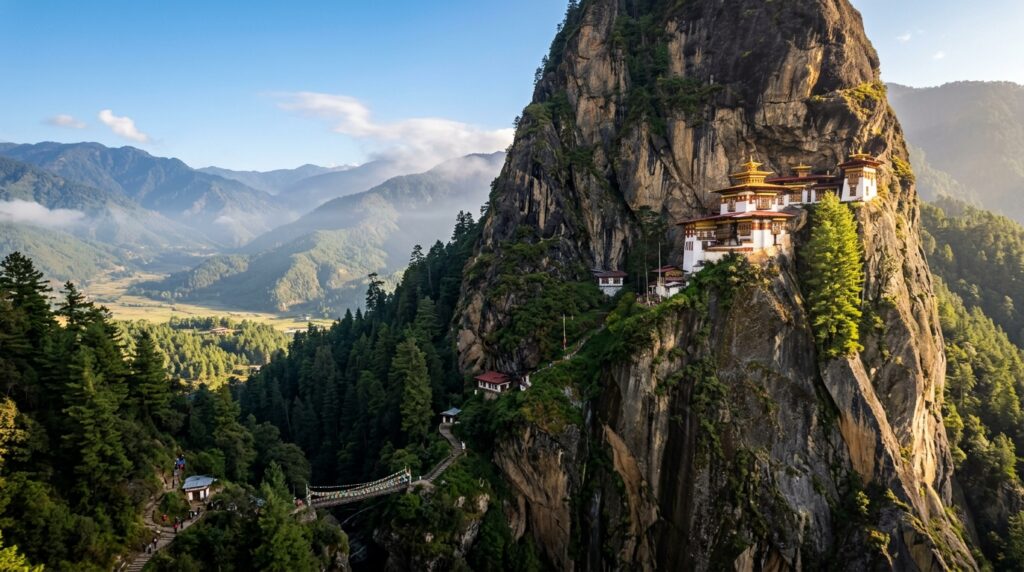
Overview Nestled high in the Eastern Himalayas, the Kingdom of Bhutan offers a mystical escape from the fast-paced life of Central India. For travelers, working professionals, and families based in Indore seeking a quick yet profoundly rejuvenating holiday, a weekend trip to Paro Tiger’s Nest from Indore (crafted as an efficient 4-Day/3-Night itinerary) provides the ultimate Himalayan retreat. Perched dramatically on a sheer granite cliff face 900 meters above the pine-scented Paro Valley (3,120 meters above sea level), Taktsang Palphug Monastery (Tiger’s Nest) stands as one of the world’s most iconic spiritual sanctuaries and bucket-list trekking destinations. Planning an international weekend getaway from Indore to Bhutan requires careful logistical planning, precise air connection timing, entry permit coordination, and proper high-altitude pacing. With direct flight connections via Delhi or Kolkata, Indori travelers can board an early morning flight from Indore’s Devi Ahilya Bai Holkar Airport (IDR) and be gazing at Bhutan’s emerald valleys and traditional dzongs by early afternoon. As Indore’s leading boutique travel consultancy, Travel Path Holiday (TPH) has designed this detailed 4D/3N weekend itinerary. Covering full logistical coordination, Sustainable Development Fee (SDF) compliance, Tiger’s Nest trail pacing, cultural sightseeing across Paro and Thimphu, and hand-vetted pure vegetarian dining setups, this guide ensures your short Himalayan vacation is seamless, comfortable, and unforgettable. Local Logistical Advice for Indore Travelers 1. Flight & Transit Coordinates from Indore (IDR to PBH) Reaching Paro International Airport (PBH) from Indore within a weekend timeframe depends on smooth flight synchronization: Connecting Flights via Delhi (DEL) or Kolkata (CCU): Depart early morning from Indore (IDR) on domestic flights (such as IndiGo or Air India) to Delhi (DEL) or Kolkata (CCU). From DEL or CCU, board connecting flights operated by Bhutan’s international flag carriers—Drukair or Bhutan Airlines—into Paro (PBH). Single-PNR & Buffer Booking: TPH strongly recommends ticketing your Indore-to-Paro segment under a single PNR or with at least a 3-hour layover window in Delhi/Kolkata. This safeguards your journey against domestic flight delays and ensures checked baggage is transferred seamlessly. Scenic Overland Option (For Extended Travel): For travelers preferring ground rail transit, board the *Malwa Express* from Indore Junction (INDB) directly to Hasimara Railway Station in West Bengal. From Hasimara, a 30-minute taxi ride brings you to the border city of Phuentsholing, where you complete immigration before driving 4 to 5 hours up to Paro. (Note: Ground transit requires 2 additional travel days and is best suited for 6D/5N packages). 2. Climate & Elevation Pacing (Malwa Plateau to Bhutan) Indore is situated on the tropical Malwa plateau at an altitude of 553 meters. In contrast, Bhutan’s key destinations sit at significantly higher elevations: Paro Valley: 2,250 meters above sea level. Thimphu City: 2,320 meters above sea level. Tiger’s Nest Monastery Summit: 3,120 meters above sea level. Ascending from Indore’s ambient dry heat to Paro’s crisp alpine air involves a drop in temperature and oxygen pressure. Morning temperatures in Paro range from 4°C to 12°C in spring and autumn, dropping near 0°C in winter. Acclimatization is essential. To avoid Acute Mountain Sickness (AMS), our 4-day itinerary places gentle valley sightseeing in Thimphu and Paro on Days 1 and 2, reserving the physical 3,120-meter Tiger’s Nest hike for Day 3 when your body has adapted to the altitude. 3. Bhutan Sustainable Development Fee (SDF) Guidelines All international travelers entering Bhutan are subject to the government-mandated Sustainable Development Fee (SDF), which funds free healthcare, education, environmental conservation, and sustainable tourism infrastructure across the kingdom: “` +———————————————————————————–+ BHUTAN SUSTAINABLE DEVELOPMENT FEE (SDF) FOR INDIAN NATIONALS +———————————————————————————–+ Adult Travelers (Ages 12 and above) : INR 1,200 per person per night Child Travelers (Ages 6 to 11) : INR 600 per child per night (50% rebate) Infants & Young Children (Under 6) : EXEMPT (No SDF fee charged) +———————————————————————————–+ “` SDF Pre-Clearance: For a 3-night weekend getaway, the total SDF for an adult Indian national is INR 3,600. Travel Path Holiday handles all online e-permit approvals and pre-pays your SDF charges prior to your departure from Indore, granting you instant, hassle-free clearance at Paro airport immigration. Required Entry Documents: Indian nationals require a valid Indian Passport (with at least 6 months validity from arrival date) OR an original Voter ID card (for adults 18+). Children under 18 without a passport must carry an original Birth Certificate along with a school ID card. 4. Prepaid SIM Cards & Mobile Connectivity No Domestic Indian Roaming: Standard Indian prepaid SIM cards (Airtel, Jio, Vi) registered in Madhya Pradesh do not function under domestic roaming plans in Bhutan. Retaining them on active international roaming incurs high data fees. Local Tourist SIM Setup: Upon landing at Paro International Airport, visit the airport arrival counters for TashiCell or B-Mobile. For approximately Nu. 500 (~INR 500), you can instantly activate a 30-day tourist eSIM or physical SIM loaded with 10GB–15GB of high-speed 4G data. Connectivity is excellent across Paro town, Thimphu city, and along the Tiger’s Nest trail. 5. Hand-Vetted Pure Vegetarian Dining Logistical Setup Indori food lovers naturally prioritize clean, hygienic, and authentic pure vegetarian dining. While traditional Bhutanese food features red rice and spicy cheese (*Ema Datshi*), meat dishes are widely served. Travel Path Holiday eliminates all dining concerns by partnering exclusively with hand-vetted vegetarian dining establishments in Paro and Thimphu. We arrange freshly cooked pure vegetarian dishes—including North Indian thalis, dal fry, paneer specialties, vegetable momos, and hot soups—prepared in hygiene-inspected kitchens. Special dietary preferences (such as onion-free and garlic-free meal preparations) can be pre-arranged with our partner hotel chefs. Complete Details & Practical Guidelines Visual Itinerary Overview (4-Day / 3-Night Weekend Route) “` =================================================================================== INDORE TO BHUTAN 4D/3N WEEKEND ITINERARY ROUTE =================================================================================== Day 1: Indore (IDR) —> Fly via DEL/CCU —> Paro Airport —> Drive to Thimphu [Buddha Dordenma • Simply Bhutan • Clock Tower Market] (Stay: Thimphu) Day 2: Thimphu Dzong & Memorial Chorten —> Scenic Drive to Paro Valley [Tashichho Dzong • Paro Rinpung Dzong • Ta Dzong] (Stay: Paro) Day 3: Full-Day Tiger’s Nest (Taktsang) Hike Pacing & Evening Hot Stone Bath [Ramthangkha Base

Bhutan Honeymoon

Hidden Gems and Quiet Spots in Dochula Pass: Offbeat Guide

Planning an Offbeat Bhutan Experience from Indore? Perched at an elevation of 3,100 meters (10,170 feet) along the mountain highway connecting Thimphu and Punakha, Dochula Pass is famous world-over for its 108 Druk Wangyal Chortens and panoramic views of the snow-capped Eastern Himalayas. However, beyond the busy photo deck frequented by tourist buses lies a serene world of hidden alpine trails, ancient mountain monasteries, dense rhododendron cloud forests, and peaceful birdwatching spots. Travel Path Holiday arranges complete offbeat Bhutan itineraries from Indore, including pre-cleared SDF permits, flight arrangements from IDR, heated 4×4 transfers, and expert certified local guides. > * Call TPH Indore: Consult Travel Path Holiday Indore * Primary Destination Hub: Explore our customized Indore to Bhutan Tour Packages Overview Stretching across the high mountain saddle between Thimphu and Punakha, Dochula Pass serves as one of Bhutan’s most iconic mountain passes. Most conventional travel itineraries schedule Dochula Pass as a brief 30-to-45-minute pitstop—just long enough for travelers to sip hot tea at the pass cafe, photograph the 108 memorial stupas, and admire the majestic peaks of the snow-covered Himalayan range (including Gangkar Puensum at 7,570 meters). However, this hurried approach misses the true magic of the Dochula ecosystem. For travelers seeking solitude, deep cultural immersion, and pristine mountain nature, Dochula Pass harbors some of western Bhutan’s finest offbeat hidden gems. Within a 5-kilometer radius of the main pass crest, you can hike through old-growth hemlock and rhododendron forests to the isolated hilltop sanctuary of Lungchutse Lhakhang, explore the tranquil retreat monk community at Trashigang Goemba, stroll through the botanical havens of Lampelri Royal Botanical Park, or spot rare Himalayan avifauna along quiet misty forest trails. Whether you are an avid hiker, nature photographer, or a traveler wanting to escape crowded tourist circuits, this guide delivers an exhaustive, step-by-step roadmap to exploring the quietest, most rewarding hidden spots around Dochula Pass. Designed specifically for travelers departing from Indore and Central India, this comprehensive guide covers exact travel coordinates, altitude preparation, seasonal tips, and custom logistics managed by Travel Path Holiday. Local Logistical Advice for Indore Travelers Traveling from the flat, tropical Malwa Plateau of Madhya Pradesh to the high-altitude cloud forests of Dochula Pass requires systematic logistical planning. Below are concrete travel guidelines compiled by Travel Path Holiday’s local travel specialists in Indore. “` +—————————————————————————————–+ INDORE TO DOCHULA PASS ROUTE [ Indore (IDR) ] —> Flight via Delhi/Kolkata —> [ Paro International Airport (PBH) ] Private SUV Transfer (Approx. 2 Hours) v [ Dochula Pass Hidden Trails (3,100m – 3,560m) ] Lungchutse Lhakhang Distance: 7 km round-trip Duration: 3.5 to 4.5 hours Difficulty: Moderate +————————————————————————————+ “` Trailhead & Coordinates: The trail begins directly behind the main trash station and prayer flag hill at Dochula Pass (3,100m). Look for the wooden archway marking the start of the nature trail. Trek Distance & Duration: 7 kilometers round-trip. Ascending takes approximately 2 to 2.5 hours; descending takes 1 to 1.5 hours. Trail Experience: The path climbs steadily through moss-draped ancient forests of blue pine, hemlock, silver fir, and giant rhododendrons. In spring (April–May), the forest floor explodes with white, pink, and deep red rhododendron blooms. In autumn (October–November), the clear blue skies reveal crisp mountain vistas through the forest canopy. The Monastery Destination: At 3,560 meters sits Lungchutse Lhakhang, a sacred 14th-century temple founded by the famous treasure revealer Terton Pema Lingpa. The monastery courtyard features a pristine lawn where a resident monk often welcomes quiet visitors with warm tea. 360-Degree Himalayan Panorama: On clear weather days, the summit deck offers an unobstructed view of Bhutan’s entire northern mountain frontier, including: Gangkar Puensum (7,570m): The world’s highest unclimbed mountain peak. Table Mountain (7,100m) & Masagang (7,194m) Tsendagang (6,960m) & Teri Kang (7,300m) Trekking Tips: The trail can be muddy after rains; waterproof hiking boots with solid ankle support are mandatory. Carry 1.5 liters of drinking water per person and lightweight energy bars. 3. Trashigang Goemba: Peaceful Meditation Monastery For travelers interested in spiritual heritage without the bustling crowds found at major dzongs (read our guide on Best Time to Visit Thimphu Dzong), Trashigang Goemba provides an authentic glimpse into Bhutanese monastic life. Location & Access: Situated downhill from Dochula Pass near the village of Hongtsho (elevation ~2,900m). Access is via a 15-minute drive down a narrow dirt branch road off the main highway, followed by a gentle 15-minute walk through pine woods. History & Significance: Founded in 1786 by the 12th Je Khenpo (Supreme Abbot of Bhutan), Kunga Jamtsho, this monastery houses sacred statues of Avalokiteshvara and historic wall paintings. The Offbeat Appeal: Trashigang Goemba serves as a primary retreat center for monks undertaking strict three-year meditation retreats. The atmosphere is profoundly quiet, filled with the gentle smell of incensed juniper and the distant chanting of prayers. Visitors can walk around the quiet courtyards, admire traditional Bhutanese woodwork, and observe daily monastic routines without any commercial tourist clutter. Visitor Protocol: Remove shoes before entering shrine rooms, refrain from photography inside the sanctum, and maintain quiet speech across the monastery grounds. 4. Royal Botanical Park, Lampelri: Bhutan’s Premier Eco Preserve Located just 2 kilometers downhill from Dochula Pass on the descent toward Punakha, Lampelri Royal Botanical Park is Bhutan’s first nature park, encompassing 42 square kilometers of protected flora and fauna. Elevation Range: Spans from 2,100 meters up to 3,800 meters, serving as an ecological bridge between the temperate broadleaf forests and alpine habitats of the Dochula ridge. Key Highlights & Attractions: Rhododendron Diversity: The park harbors 29 out of Bhutan’s 46 indigenous rhododendron species. The best time to visit is during the annual Rhododendron Festival held in mid-April, when the gardens bloom into vibrant colors. Baritsho Lake: A pristine natural lake within the park surrounded by prayer flags, serving as a sanctuary for migratory waterbirds such as the bar-headed goose. Tree Canopy Walkway: A wooden boardwalk that loops through dense forest foliage, ideal for seniors and families with children seeking a gentle walk without steep climbing. Eco-Huts & Picnic Lawns: Clean, covered

Bhutan Honeymoon

Photography and Sunset Spots in Punakha Suspension Bridge: Guide

Overview The Punakha Suspension Bridge—stretching 180 meters across the rush of the turquoise Pho Chhu river—is one of the most iconic landscape and sunset photography spots in the Kingdom of Bhutan. Draped in hundreds of fluttering prayer flags (*Lungta*) and set against the dramatic backdrop of the Punakha Valley’s terraced hills, this historic footbridge offers photographers an extraordinary palette of texture, color, and depth. Located just a short drive from the majestic Punakha Dzong (*Pungtang Dechen Photrang Phodrang*), the area surrounding the bridge and the river confluence provides golden hour lighting, crystal-clear water reflections, and authentic cultural perspectives. For photography enthusiasts, content creators, and travelers seeking breathtaking visual memories, mastering the angles, timing, exposure settings, and local aviation regulations around Punakha is essential. This guide covers prime photography vantage points across Punakha Suspension Bridge and Punakha Dzong, exact camera settings for capturing silky river reflections, golden hour timing, cultural photography etiquette, and strict drone laws enforced in Bhutan. Local Logistical Advice for Indore Travelers Planning a photography expedition to Bhutan from Central India requires structured travel coordinates. Departures from Indore demand clear alignment between flight legs, overland road journeys, climate adjustments, and mobile connectivity. Direct Transit Options from Indore (IDR) to Paro (PBH) Air Route via Delhi or Kolkata: Fly from Indore’s Devi Ahilya Bai Holkar Airport (IDR) to Indira Gandhi International Airport (DEL) in New Delhi or Netaji Subhash Chandra Bose International Airport (CCU) in Kolkata. From Delhi or Kolkata, catch connecting international flights operated by Drukair (Royal Bhutan Airlines) or Bhutan Airlines directly into Paro International Airport (PBH). Overland Route via Bagdogra: Take a domestic flight from Indore to Bagdogra Airport (IXB) in West Bengal or an express train to New Jalpaiguri (NJP) or Hasimara. From Bagdogra, hire a pre-arranged private vehicle for a 4-hour scenic drive to the Indian border town of Jaigaon, crossing into Phuntsholing, Bhutan, to clear regional entry permits. Driving Route & Distance to Punakha Valley From Paro International Airport or the capital city of Thimphu, Punakha is accessed via a scenic drive along the East-West Highway: Distance: Approximately 125 km from Paro (or 75 km from Thimphu). Travel Time: 3.5 to 4 hours by private vehicle. Dochula Pass Transit: The drive crosses the famous Dochula Pass (3,100 meters), home to 108 memorial chortens (*Druk Wangyal Chortens*). On clear days, Dochula offers panoramic views of the snow-capped Eastern Himalayas—an ideal morning photography stop en route to Punakha. Climate Transition: Indore vs. Punakha Valley Travelers transitioning from Indore’s tropical dry savanna climate (where temperatures range from 30°C to 42°C in summer and 12°C to 28°C in winter) will find Punakha’s climate distinctly comfortable: Elevation: Punakha sits at a lower altitude of approximately 1,200 to 1,300 meters, making it significantly warmer than Thimphu or Paro. Spring (March to May): Day temperatures range between 18°C and 26°C. Purple jacaranda trees bloom around Punakha Dzong in April and May, creating stunning color contrast against the white fortress walls. Autumn (September to November): Crisp skies, pleasant sunshine (16°C to 24°C), and crystal-clear river waters ideal for reflection photography. Winter (December to February): Mild daytime temperatures (14°C to 18°C) with cool evenings (4°C to 8°C). Warm layered clothing and heavy jackets are recommended for golden hour sessions along the riverbanks. Bhutan Sustainable Development Fee (SDF) & Entry Permits SDF for Indian Nationals: Under Bhutanese regulations, Indian passport and voter ID holders pay a Sustainable Development Fee (SDF) of ₹1,200 per adult per night (children aged 6 to 12 pay ₹600 per night). Permit Clearance: Entry permits are issued online in advance or at the entry checkpoints in Phuntsholing and Paro. Carry original valid passports or Voter Cards along with passport-sized color photographs. Mobile Connectivity & Local Prepaid SIMs Standard Indian prepaid SIM cards (Airtel, Jio, Vi registered under the MP telecom circle) do not operate under domestic national roaming in Bhutan. To upload high-resolution photographs, access navigation, and keep in touch: Purchase a local tourist prepaid SIM or eSIM from TashiCell or B-Mobile upon arrival at Paro International Airport or the Phuntsholing entry gate. Packages cost approximately Nu/INR 200 to Nu/INR 500 and provide generous 4G data allowances valid across the Punakha Valley. Complete Details & Practical Guidelines Prime Photography & Sunset Spots in Punakha “` [ Punakha Valley Vantage Overview ] +——————————————————-+ Punakha Suspension Bridge (180m length, prayer flags, high-angle river) +—————————+—————————+ v Pho Chhu River (Male) +—————————+—————————+ Pho Chhu Pebble Riverbanks & Shorelines (Low-angle long-exposures & framing under bridge) +—————————+—————————+ v +—————————+—————————+ Pho Chhu & Mo Chhu Confluence (Sangam Point) (Punakha Dzong reflections, Jacarandas, Golden Hour) +——————————————————-+ “` #### 1. The Western Bridgehead of Punakha Suspension Bridge Vantage Point: Standing at the western wooden ramp of the bridge looking across toward the village of Shengana. Compositional Elements: The wooden planks and steel cables create natural leading lines that pull the viewer’s eye through the frame. Flanking lines of colorful Buddhist prayer flags add vibrant reds, blues, greens, yellows, and whites. Best Time: Early morning (7:00 AM – 8:30 AM) when wind speeds are low (minimizing bridge motion and flag flutter) and soft directional sunlight lights up the valley floor. #### 2. Pebble Riverbanks of the Pho Chhu (Below the Bridge) Vantage Point: Follow the marked footpath down to the gravel and pebble riverbanks directly beneath the suspension bridge. Compositional Elements: Shoot looking upward to capture the dramatic span of the bridge towering high above the turquoise water. Position smooth river boulders in the foreground for added depth. Best Time: Mid-to-late afternoon (3:30 PM – 4:45 PM), when side-lighting illuminates the bridge structure and accentuates water ripples. #### 3. Pho Chhu & Mo Chhu Confluence (Sangam & Punakha Dzong Sunset Spot) Vantage Point: Positioned along the eastern embankment where the Pho Chhu (male river) merges with the Mo Chhu (female river), approximately 1.2 km downstream from the suspension bridge. Compositional Elements: The majestic Punakha Dzong sits gracefully at the point of confluence. During golden hour, the low sun casts a warm amber glow across the whitewashed fortress walls,

Bhutan Honeymoon

Best Honeymoon Resorts in Thimphu Dzong for Couples

Overview Thimphu Dzong (the capital valley of the Kingdom of Bhutan) offers an enchanting blend of ancient Himalayan serenity, vibrant royal heritage, and breathtaking high-altitude mountain scenery, making it one of the world’s most romantic honeymoon destinations. For newly married couples seeking an intimate escape away from crowded commercial hill stations, Thimphu presents an extraordinary array of luxury honeymoon resorts and heritage retreats. Nestled amidst whispering blue-pine forests, overlooking the winding Wangchu River or facing the majestic illuminated fortress of Tashichho Dzong, these properties redefine romance. From ultra-exclusive sanctuaries featuring private infinity reflection pools and centuries-old traditional wood-burning *Bukhari* stoves to modern five-star havens equipped with hydronic central heating and radiant underfloor warmth, staying in Thimphu Dzong ensures uncompromised comfort even during chilly Himalayan nights. Couples can indulge in traditional Bhutanese *Dotsho* (herbal hot stone baths), private starlit candlelight dining featuring hand-vetted vegetarian options, and private monastic blessings for a prosperous union. This definitive guide details the top honeymoon resorts in Thimphu Dzong, complete with room amenities, heating capabilities, candlelight dining setups, tariff breakdowns, and seamless travel logistics tailored for couples departing from Central India. Local Logistical Advice for Indore Travelers Planning an international honeymoon from Indore to the Land of the Thunder Dragon requires smooth transit coordination, climate acclimatization, and mobile connectivity setup. Here are concrete, actionable travel guidelines for couples traveling from Madhya Pradesh: Flight and Overland Route Coordinates from Indore (IDR) Air Transit via Kolkata/Delhi: The fastest and most comfortable route from Indore is flying from Devi Ahilya Bai Holkar Airport (IDR) to Netaji Subhash Chandra Bose International Airport, Kolkata (CCU) or Indira Gandhi International Airport, Delhi (DEL) via early morning flights (operated by Air India or IndiGo). From Kolkata or Delhi, board an international connecting flight on Drukair (Royal Bhutan Airlines) or Bhutan Airlines directly into Paro International Airport (PBH). Upon landing in Paro, your private chauffeured vehicle arranged by Travel Path Holiday will take you on a scenic 1.5-hour drive (approx. 50 km) along the paring river highways straight into Thimphu Valley. Overland Scenic Entry: Alternatively, couples planning a relaxed multi-stop journey can travel by air or train (such as the Malwa Express or Ahilya Nagari Express connecting routes) to Bagdogra Airport (IXB) or New Jalpaiguri (NJP) / Hashimara (HSA) in West Bengal. From there, a private 4-hour drive brings you to the Indian border town of Jaigaon and Phuentsholing, Bhutan. After smooth immigration clearance, enjoy a stunning 4.5-hour mountain highway drive (165 km) past pine-clad peaks directly into Thimphu Dzong. Climate Transition & Winterization Essentials Temperature Shift: Travelers departing from Indore’s dry, tropical climate (where daytime temperatures often exceed 30°C to 35°C for much of the year) will experience an immediate transition upon reaching Thimphu’s altitude of 2,320 meters (7,612 feet). Seasonal Conditions: Spring (March to May) and Autumn (September to November) offer crisp, clear days with temperatures ranging between 10°C and 22°C, while evening temperatures drop swiftly to 4°C–8°C. Winters (December to February) bring severe mountain chills, with night temperatures frequently plunging below freezing (-5°C to 3°C). Heating Importance: Selecting a resort with verified central radiator heating, double-pane insulated windows, and radiant underfloor heating is essential. For winter departures, packing layered thermals, cashmere scarves, and windproof outer jackets ensures you remain warm during evening outdoor candlelight dinners. For comprehensive weather patterns throughout the year, review our detailed guide on the Best Time to Visit Thimphu Dzong. International SIM Cards & Mobile Connectivity Roaming Status: Standard Indian prepaid mobile SIM cards issued in Madhya Pradesh (such as Airtel, Jio, or Vi) do not operate in Bhutan under regular national roaming. Local Tourist SIM Setup: Upon arrival at Paro International Airport’s main terminal or the Phuentsholing entry gate, couples should purchase a local Bhutanese Tourist SIM or eSIM from B-Mobile (Bhutan Telecom) or TashiCell. A 15-day tourist SIM card costs between Nu/INR 500 and Nu/INR 1,100 ($6 to $13), providing robust 4G data coverage across Thimphu Dzong to easily share your honeymoon photos and stay connected with family back in Indore. Custom Vegetarian Meal Arrangements Dietary Comfort: Indori travelers accustomed to pure vegetarian meals will find Bhutanese luxury resorts exceptionally accommodating. Top properties in Thimphu Dzong offer hand-vetted vegetarian options/dining, featuring freshly cooked pure vegetarian dishes, light sattvik preparation options without onion or garlic upon prior request, and authentic North Indian flatbreads prepared by specialized in-house chefs. Complete Details & Practical Guidelines 1. Top Luxury & Heritage Honeymoon Resorts in Thimphu Dzong #### A. Six Senses Thimphu (“Palace in the Sky”) Perched grandly on the mountainside of Chunimading, Six Senses Thimphu is affectionately nicknamed the “Palace in the Sky.” Overlooking the timbered valley of Thimphu and the distant majestic outline of Tashichho Dzong, this ultra-luxury resort combines traditional Dzong-inspired grand timber architecture with sleek modern minimalism. Honeymoon & Romantic Features: Floor-to-ceiling glass windows in every suite offering panoramic mountain vistas, private infinity reflection pools that merge into the horizon, outdoor fire pits for romantic starlit evenings, and couple’s treatment suites in the world-renowned Six Senses Spa. Heating & Climate Control: Comprehensive radiant underfloor heating, automated central hydronic climate control, and double-glazed floor-to-ceiling thermal glass panels ensuring cozy indoor warmth regardless of outdoor sub-zero chills. Candlelight & Culinary Dining: Private candlelit dining setups floating over the reflection pond or held inside a secluded pine forest pavilion. The culinary team crafts bespoke multi-course menus, including exquisite hand-vetted vegetarian options/dining paired with non-alcoholic artisanal botanical elixirs or fine international wines. Tariff Range: ₹95,000 – ₹1,65,000 per night (subject to 10% service charge and applicable taxes). #### B. Amankora Thimphu Set within a secluded blue-pine forest in the upper Motithang area of Thimphu Dzong, Amankora Thimphu is a sanctuary of peace, understated luxury, and deep Bhutanese heritage. Built in the style of a traditional Dzong fortress with whitewashed rammed-earth walls and soaring timber roofs, it offers couples complete privacy and serenity. Honeymoon & Romantic Features: Intimate suite layouts featuring terrazzo soaking tubs placed alongside expansive window seats, secluded forest courtyards, guided private morning forest walks, and customized couple’s

Bhutan Honeymoon

Things to Avoid in Paro Tigers Nest: Tourist Safety Guidelines

Overview Perched on a sheer granite cliff face 900 meters above the pine-scented Paro Valley (at an elevation of 3,120 meters above sea level), Taktsang Palphug Monastery, world-renowned as Tiger’s Nest, stands as Bhutan’s most iconic spiritual sanctuary and trekking experience. According to 8th-century Himalayan lore, Guru Rinpoche (Padmasambhava) flew to this cave on the back of a tigress to meditate, consecrating the mountain as sacred ground. While ascending to this architectural marvel is a bucket-list dream for travelers departing from Central India, the high-altitude terrain, steep cliffside pathways, and strict monastic decorum require careful physical preparation and cultural awareness. Mistakes such as rushing the 9-kilometer round-trip hike without proper acclimatization, improper pony usage on steep declines, wearing inadequate footwear, violating sacred temple dress codes, or taking unauthorized interior photographs can turn a spiritual pilgrimage into a hazardous or distressing experience. As Indore’s premier custom travel advisory, Travel Path Holiday (TPH) has crafted this definitive safety guide detailing the critical things to avoid at Paro Tiger’s Nest. Designed specifically for Indori travelers, this guide provides essential advice on high-altitude safety, trail logistics, monastic etiquette, and climate adjustments to ensure your journey is safe, comfortable, and deeply rewarding. Local Logistical Advice for Indore Travelers 1. Flight & Transit Coordinates from Indore For travelers departing from Indore’s Devi Ahilya Bai Holkar Airport (IDR), reaching Paro involves crossing international borders into a high-altitude alpine environment: Air Routes via Delhi or Kolkata: Take a early morning connection from Indore (IDR) to Indira Gandhi International Airport in Delhi (DEL) or Netaji Subhash Chandra Bose International Airport in Kolkata (CCU). From DEL or CCU, board an international connecting flight operated by Bhutan’s national carriers—Drukair or Bhutan Airlines—into Paro International Airport (PBH). Single-PNR Booking Advantage: Always ensure your flights from Indore to Paro are ticketed under a single PNR or coordinated with adequate buffer windows. This guarantees that your checked luggage is seamlessly transferred and protects you against missed connections caused by domestic flight delays. Overland Train/Road Option: Travelers who prefer ground transit can board the *Malwa Express* or connecting express trains from Indore Junction (INDB) to Hasimara Railway Station in West Bengal. From Hasimara, a short 30-minute taxi ride brings you to the border town of Phuentsholing, where you complete immigration before driving 4 to 5 hours up the scenic mountain highways to Paro. 2. Climate & Altitude Transition (Indore to Paro) Indore lies in the Malwa plateau at an altitude of approximately 553 meters, characterized by a warm, dry tropical climate. In contrast, Paro town sits at 2,250 meters, and the Tiger’s Nest summit reaches 3,120 meters above sea level. Oxygen & Temperature Drop: As you ascend from Indore’s ambient warmth to Paro’s high altitude, air density and oxygen pressure decrease significantly. Morning temperatures on the trail frequently drop below 5°C during spring and autumn, while winter temperatures can dip near freezing. Acclimatization Rule: NEVER schedule the Tiger’s Nest hike on Day 1 or Day 2 of your Bhutan itinerary. Attempting a 3,120-meter trek immediately after arriving from Central India increases the risk of altitude sickness. Travel Path Holiday structures your tour to place the Taktsang hike on Day 4 or Day 5, after you have acclimatized during lower-elevation sightseeing in Thimphu (2,320 m) and Punakha (1,300 m). 3. Prepaid SIM Cards & Mobile Connectivity No Domestic Indian Roaming: Standard prepaid SIM cards from Airtel, Jio, or Vi issued in Madhya Pradesh will not work under standard Indian domestic tariffs in Bhutan. Upon crossing the border or landing in Paro, they automatically switch to expensive international roaming rates. Buy a Local Tourist SIM: Upon arrival at Paro International Airport or the Phuentsholing immigration gate, purchase a local tourist SIM or eSIM from TashiCell or B-Mobile. A 30-day tourist data card costs approximately Nu. 500 (~INR 500) and provides reliable 4G connectivity across Paro Valley and the lower sections of the Tiger’s Nest trail. 4. Sustainable Development Fee (SDF) Clearances All Indian nationals visiting Bhutan must pay the official Sustainable Development Fee (SDF) of INR 1,200 per adult per night (children aged 6 to 12 receive a 50% discount; children under 6 are exempt). Travel Path Holiday pre-clears all SDF permits and entry vouchers before your departure from Indore, eliminating paperwork delays at airport immigration. 5. Pure Vegetarian Dining Logistics Bhutanese local cuisine relies heavily on local spices, chilies (*Ema Datshi*), and non-vegetarian stews. For Indori travelers who prefer hand-vetted vegetarian options or freshly cooked pure vegetarian dishes prepared without onion or garlic, TPH coordinates directly with partner resort kitchens in Paro. We arrange hot thermoses of herbal ginger-lemon tea and fresh vegetarian energy packs for your trekking day. Complete Details & Practical Guidelines “` =================================================================================== TAKTSANG (TIGER’S NEST) TRAIL PROFILE =================================================================================== Trailhead (Ramthangkha) Mid-Way Cafeteria Monastery Summit Elevation: 2,600 m Elevation: 2,940 m Elevation: 3,120 m ———————– ———————- ——————- [START] —> 2.0 km Uphill —> [REST & PONY STOP] —> 700 Stone Steps —> [TEMPLE] (Dirt Switchbacks) (Cliff Gorge & Bridge) =================================================================================== “` 1. Steep Climbing & Trail Hazards: Critical Mistakes to Avoid The trail to Tiger’s Nest covers approximately 4.5 kilometers uphill (9 kilometers round trip) with a total vertical elevation gain of over 550 meters. The terrain transitions from dusty pine-forest dirt tracks to rocky slopes, ending in a flight of over 700 narrow stone steps cut directly into the cliff side. Avoid Rushing the Ascent: Pushing a rapid pace during the initial dirt switchbacks causes sudden exhaustion, elevated heart rates, and muscle strain. Maintain a steady, rhythmic breathing pace. Take small, measured steps and schedule 2-minute standing breaks every 20 minutes. Avoid Wearing Casual or Smooth-Soled Shoes: DO NOT attempt this hike in flat sneakers, canvas shoes, slip-ons, or un-broken-in leather footwear. The trail contains loose gravel, exposed tree roots, and damp mud. Wear sturdy, ankle-high trekking boots with deep rubber lug soles (Vibram treads) to prevent slipping and protect your ankles from roll injuries. Avoid Trekking Without Walking Poles: Hiking without trekking poles places excessive impact on your knees and

Bhutan Honeymoon

Luxury Resorts in Dochula Pass: Premium Stays & Villas

Planning a Luxury Bhutan Getaway from Indore? Dochula Pass sits at an elevation of 3,100 meters (10,170 feet) along the mountain highway between Thimphu and Punakha. Staying in a luxury resort or alpine villa around this pass offers uninterrupted views of the snow-capped Eastern Himalayas, including Bhutan’s highest peak, Gangkar Puensum (7,570m). Travel Path Holiday arranges complete high-end packages featuring pre-cleared SDF permits, flight bookings from Indore, luxury heated vehicle transfers, and hand-picked resort reservations with central heating. > * Call TPH Indore: Consult Travel Path Holiday Indore * Primary Destination Hub: Explore our customized Indore to Bhutan Tour Packages Overview Perched at a commanding altitude of 3,100 meters (10,170 feet) on the mountain highway connecting Thimphu and Punakha, Dochula Pass is celebrated worldwide for its 108 memorial stupas—the Druk Wangyal Chortens—and its mesmerizing, 180-degree panoramic vista of the snow-capped Himalayan ranges. While many day-tourists stop briefly at the pass for photographs before descending down to Punakha or returning to Thimphu, discerning travelers choose to anchor their Bhutanese vacation in the luxury resorts, mountain lodges, and high-altitude private villas situated in and around the Dochula Pass corridor. Staying near Dochula Pass places you in the heart of Bhutan’s tranquil cloud forests and pine-forested ridges. Awakening to sub-zero alpine mists yielding to brilliant morning sunlight over 7,000-meter peaks is an experience matched by very few mountain destinations on earth. However, due to the high elevation and mountain winds, temperatures at Dochula Pass often hover between 5°C and 15°C during spring and autumn, dropping well below freezing (-5°C to 2°C) during winter nights. To ensure absolute warmth and refined comfort, top-tier accommodations around Dochula Pass and its surrounding ridges feature state-of-the-art climate control systems—ranging from hydronic underfloor radiant heating and double-glazed floor-to-ceiling panoramic glass walls to traditional Bhutanese *bukhari* (wood-burning stove) fireplaces. This comprehensive guide covers the finest luxury stays, villa categories, room amenities, night tariffs, and essential logistical advice tailored for travelers departing from Indore and Central India. Local Logistical Advice for Indore Travelers Planning a seamless luxury holiday from Indore to the high-altitude terrain of Dochula Pass requires careful flight routing, climate adjustments, SIM card management, and local currency preparation. Below are actionable coordinates compiled by Travel Path Holiday’s local travel advisors. 1. Flight & Transit Routes from Indore (IDR) to Bhutan Travelers departing from Indore’s Devi Ahilya Bai Holkar Airport (IDR) have two primary entry choices to reach Bhutan: Option A: Direct Air Route via Delhi/Kolkata (Recommended) Segment 1: Board an early morning domestic flight from Indore (IDR) to New Delhi (DEL) or Kolkata (CCU) via IndiGo or Air India. Segment 2: Catch a connecting international flight operated by Drukair (Royal Bhutan Airlines) or Bhutan Airlines from Delhi or Kolkata to Paro International Airport (PBH). Ground Transfer to Dochula: From Paro Airport, your private chauffeur in a luxury SUV (such as a Toyota Innova Crysta or Fortuner) will drive you through Thimphu to Dochula Pass—a scenic 2-hour drive (approx. 65 km) over smooth tarmac winding through blue pine forests. Option B: Air-cum-Overland Route via Bagdogra (IXB) Segment 1: Fly from Indore (IDR) to Bagdogra Airport (IXB) in West Bengal (connecting through Delhi). Segment 2: Take a private chauffeured transfer from Bagdogra across the border into Phuentsholing, Bhutan (approx. 4.5 hours drive). Segment 3: Ascend from Phuentsholing up the mountain highway to Thimphu and Dochula Pass (approx. 5.5 to 6 hours drive). Sustainable Development Fee (SDF) & Entry Permits: Indian citizens are required to pay the Sustainable Development Fee (SDF) of INR 1,200 per adult per night (children aged 6 to 12 pay INR 600/night). Travel Path Holiday pre-pays your SDF and clears your entry permits prior to your departure from Indore, eliminating queue times at Paro Airport or Phuentsholing border control. 2. Altitude Transition & Climate Preparedness Indore lies on the Malwa Plateau at an elevation of approximately 550 meters, characterized by warm to dry tropical weather for most of the year. Transitioning to Dochula Pass at 3,100 meters (10,170 feet) involves a dramatic shift in altitude and climate. Acclimatization Strategy: We recommend spending your first 1 or 2 nights at Paro (2,250m) or Thimphu (2,320m) before overnighting at high-altitude pass resorts (3,100m). This gradual ascent ensures smooth acclimatization without altitude discomfort. Packing for Altitude Chill: Even during summer months (May–July), evening temperatures at Dochula Pass drop to 10°C–12°C. For autumn and winter trips (October–February), heavy thermal baselayers, down jackets, cashmere scarves, and thermal socks are mandatory. 3. Prepaid SIM Cards & Mobile Connectivity Standard Indian mobile SIM cards (Airtel, Jio, Vi) cease domestic roaming upon crossing the Bhutanese border unless international roaming packages are activated prior to departure. Local Tourist SIM / eSIM: Upon arrival at Paro International Airport or the Phuentsholing immigration office, travelers can easily obtain a local tourist SIM card or eSIM from TashiCell or B-Mobile. Cost & Packages: A tourist SIM card costs approximately BTN / INR 500, which includes 10 GB to 15 GB of high-speed 4G data valid for 7 to 14 days. Resort Wi-Fi: All luxury resorts near Dochula Pass provide complimentary high-speed Wi-Fi across their guest rooms, villas, and public lounges, ensuring seamless connectivity with family back in MP. 4. Currency & Financial Logistics The local currency is the Bhutanese Ngultrum (BTN), which is officially pegged 1:1 with the Indian Rupee (INR). Indian Rupee currency notes of ₹100 and ₹500 are widely accepted across all shops, restaurants, and resorts in Bhutan. Luxury resorts accept international credit cards (Visa/Mastercard), but carrying ₹15,000 to ₹25,000 in cash is advisable for tipping driver-guides and purchasing authentic local handicrafts along the pass. Complete Details & Practical Guidelines Top Luxury Resorts, Eco-Lodges & Premium Cottages Near Dochula Pass Choosing the right accommodation near Dochula Pass depends on your preference for immediate pass proximity versus luxury mountain ridge sanctuaries situated along the Thimphu-Dochula-Punakha highway corridor. Here is an in-depth review of the top high-end stay options: “` +———————————————————————————–+ DOCHULA PASS LUXURY RESORT BELT [ Thimphu Valley ] [ Dochula Pass (3,100m) ] [ Punakha Valley

You have been successfully Subscribed! Ops! Something went wrong, please try again.

About Us

Travel Path Holiday is a full-service travel company dedicated to delivering seamless, personalized, and memorable travel experiences. We specialize in crafting customized journeys for both corporate and leisure travelers, ensuring every trip is stress-free and enjoyable.

Destinations

Kashmir

Manali

Leh-Ladakh

Nepal

Bhutan

Blog

  • All Post
  • Adventure, Trekking & Road Trips
  • Andaman
  • Bali Honeymoon
  • Bhutan Honeymoon
  • Dubai Honeymoon
  • Family & Leisure
  • Goa Honeymoon
  • Gujarat
  • Himachal Honeymoon
  • Himachal Pradesh
  • Honeymoon & Romance
  • India Travel Guides
  • Kashmir Honeymoon
  • Kerala Honeymoon
  • Nepal Honeymoon
  • Rajasthan Honeymoon
  • Seasonal & Monsoon Specials
  • Sikkim & Northeast
  • Singapore Honeymoon
  • Spiritual & Pilgrimage
  • Thailand
  • Tour Packages & Guides
  • Uttarakhand Honeymoon

Travel Path Holiday, Indore | © 2026 Travel Path Holiday. All Rights Reserved. | Website crafted by Amit Nayak, India

Scroll to Top